M&M’s Going Dye-Free Is Harder Than It Looks? Only When You Lock In on Spirulina.
Mars artificial dye-free reformulation of M&M's is exposing the real technical cost of clean-label confectionery at industrial scale.

Blue is genuinely hard. The bigger lesson is what happens when you bet a whole palette on one finicky ingredient.
TLDR
- Dye-free M&M’s launch in August without blue or brown, citing cost and reformulation hurdles.
- M&M’s are panned candies; color rides in on a sprayed finishing syrup, which is exactly where spirulina clogged and failed.
- Leaning on one colorant (blue-green spirulina) for green, blue, and brown was the real constraint, not a shortage of natural options.
- Brown never needed blue: Class I plain caramel, cocoa, and upcycled apple-peel browns deliver the vintage tan.
- The reflex fix, annatto, is the wrong hue for blue or brown, and its supply is already tightening. The answer is a palette, not a hero ingredient.
When Mars rolls out dye-free M&M’s this August, two colors won’t be in the first bags: blue and brown. The Wall Street Journal reports the switch has been complex and costly, and Mars isn’t overstating the effort; the company spent millions and installed hundreds of specialized machines chasing a natural blue. That difficulty is real. Blue is the hardest color in the natural palette, full stop.
But the more useful story is how Mars got boxed in, because it’s the trap every reformulating brand is walking toward.
It Starts With How an M&M Is Made
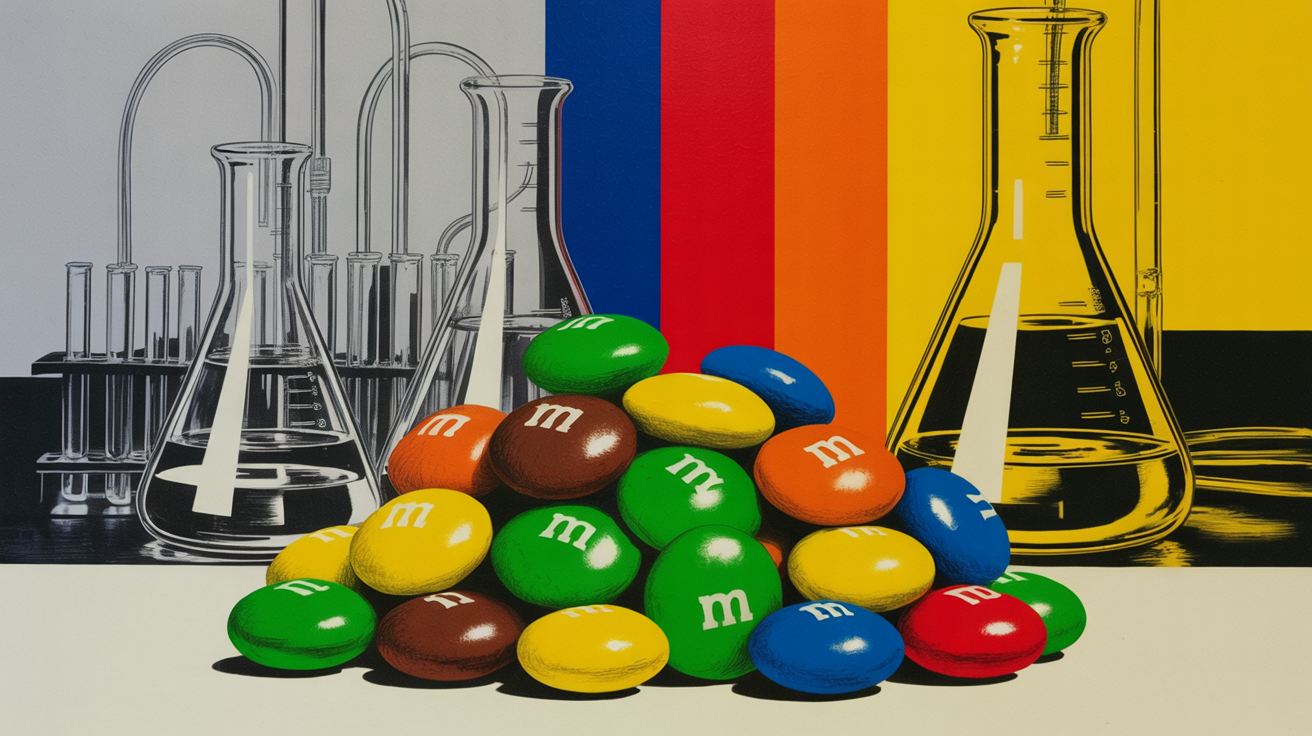
M&M’s are panned candies. Bare chocolate centers tumble in rotating pans while thin layers of sugar syrup build up, each drying before the next, with the color riding in on the final syrup, applied by spray. That last detail matters. A colorant here has to spray cleanly, layer evenly, and survive drying at volume. It is one of the most demanding jobs you can hand a pigment.
Mars leaned on spirulina, a blue-green algae extract, to carry it. Spirulina is a fine green. Stretched toward blue and brown, it turned costly and thick; thick enough to clog the spray nozzles, by the Journal’s own account, and it needed several times the volume to land a blue. One ingredient, asked to do three jobs, in the toughest possible process.
Brown Never Needed a Blue
The reporting notes that brown “contains a surprising amount of blue.” That is true only if you are rebuilding Mars’s specific spirulina brown. Step outside it and brown is the easy one. Class I caramel, the single clean caramel class made without ammonia or sulfites, has colored confectionery for years. Cocoa is itself brown. And upcycled apple-peel extracts, helped by newer drying techniques, now deliver everything from golden tan to deep brown. The warm tan an M&M wore for decades is not a mystery. It is sitting on the shelf.
The Annatto Trap
Here is where the industry reflex goes wrong. The moment a brand says “natural,” a dozen suppliers pitch annatto. Two problems. First, annatto is a yellow-to-orange carotenoid; it does not make blue, and it does not make brown. Second, the version usually pitched, oil-soluble bixin, is the wrong tool for a water-based panning syrup, which wants water-soluble norbixin instead. And even the right form is exposed: annatto comes mostly from Brazil and Peru, a 2023 drought spiked prices roughly 40 percent in six months, and phase-out demand is climbing now. Pile the category onto one crop and you trade a dye problem for a supply problem.
A Palette, Not a Hero Ingredient
The brands that clear this do not hunt for a single magic swap. They compose. Blue alone now has four approved natural sources, including gardenia blue, cleared for hard and soft candies in 2025, plus spirulina, galdieria extract, and butterfly pea. The wider market draws on roughly 70 crops, along with microbial and mineral pigments, and the strong houses blend them to a target shade. Natural reds often lean purple; natural yellows carry orange or green undertones. As single ingredients, that looks like a gap. As a palette, it is range.
None of this makes Mars’s work easy or cheap, and shipping four colors instead of six is an honest snapshot of where one company’s process sits today. But the lesson generalizes. The reformulators who win won’t be the ones who find the perfect drop-in. They’ll be the ones who stop looking for it; who treat color as a system to compose and a supply to de-risk. The colors aren’t missing. The strategy was.
Sources: The Wall Street Journal; ConfectioneryNews; U.S. Food and Drug Administration; DyeConverter.