
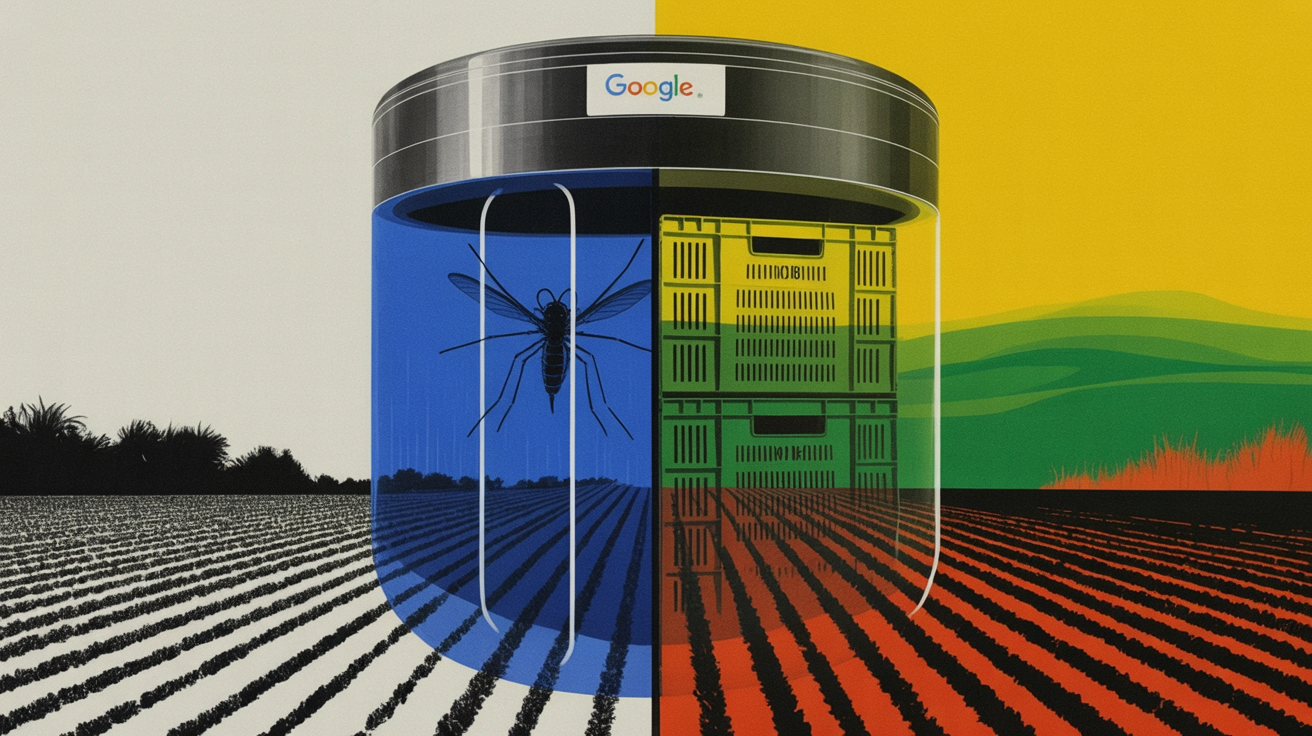
Google’s 32 Million Mosquito Release Has a Food Angle
Google's mosquito release program targets disease-carrying insects in California and Florida, with quiet implications for outdoor food and agriculture supply chains.

Google wants to release up to 32 million sterile male mosquitoes across California and Florida. The Google mosquito release program, run through its Verily life sciences unit, aims to suppress invasive Aedes aegypti populations. Food operators near affected zones should pay attention.
TLDR
- Verily, Google’s life sciences arm, leads the sterile mosquito effort.
- Sterile males suppress invasive Aedes aegypti without pesticide use.
- California and Florida are the initial target states for release.
- Reduced pesticide pressure could benefit clean-label produce supply chains.
- Regulatory approval and community consent remain active hurdles.
What the Google Mosquito Release Program Actually Does
Verily, Google’s life sciences subsidiary, breeds sterile male Aedes aegypti mosquitoes in controlled facilities. Males do not bite. When released, they mate with wild females, producing no viable offspring.
The target species is invasive. Aedes aegypti carries dengue, Zika, and chikungunya. It is not native to the continental United States.
Verily’s Debug Project has previously run trials in Fresno, California. Results showed significant local population suppression. Scale is the new variable.
Up to 32 million mosquitoes would be released across both states. That number sounds alarming. Context matters: all released insects are sterile males.
Why Food Operators Should Track This
Pesticide reduction is a direct downstream benefit. Outdoor produce growers in Florida and California face recurring pressure from Aedes aegypti-linked public health responses. Those responses often involve broad chemical applications.
Clean-label produce suppliers know the problem well. Residue concerns follow aerial or ground-level mosquito abatement programs. A biological suppression alternative changes that calculus.
Additionally, farm worker health is a supply chain issue. Dengue and Zika outbreaks disrupt labor availability in agricultural regions. Suppressing the vector reduces that operational risk.
The future of food increasingly runs through biological and precision tools, not legacy chemistry. This program fits that arc.
However, regulatory clearance is not guaranteed. Community acceptance in target counties varies. Operators should monitor local approval timelines before adjusting sourcing assumptions.
In short, the Google mosquito release program is not a food story yet. It is becoming one.
Source: The Hill. https://thehill.com/policy/technology/5903579-google-mosquito-debugging-program/