
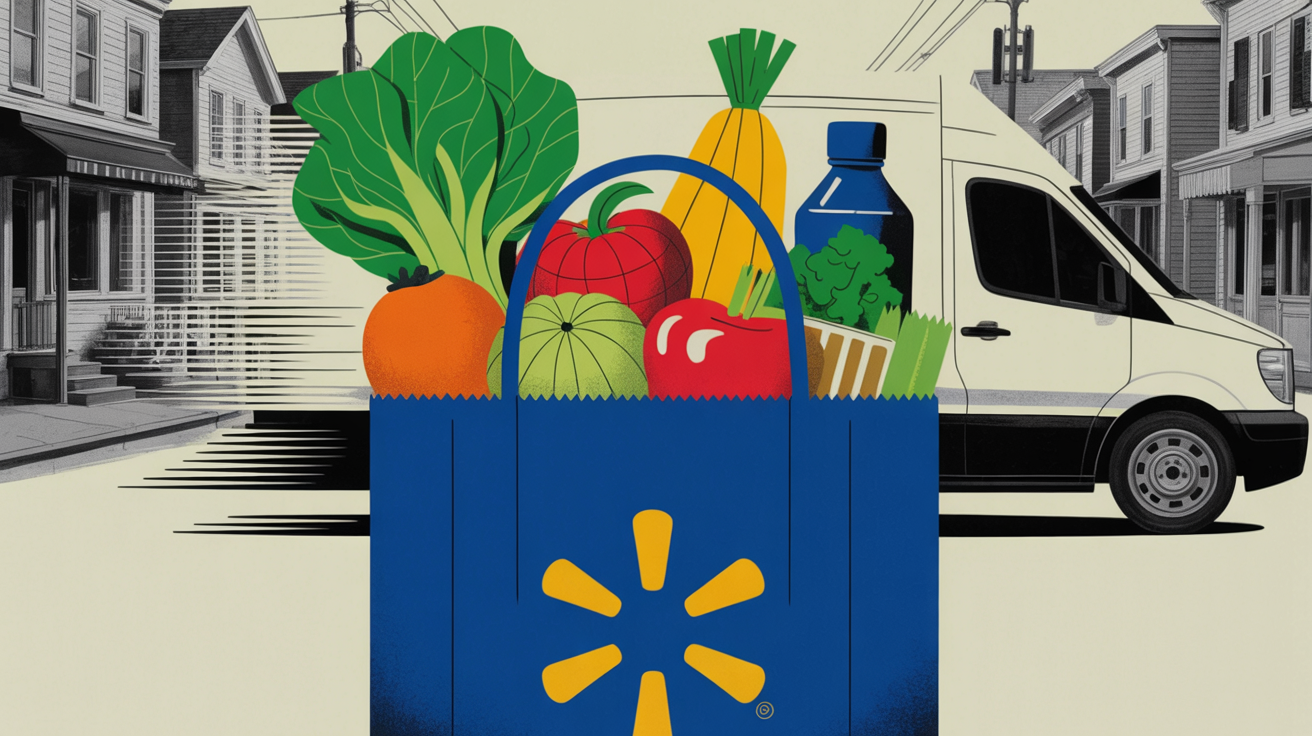
Amazon and Walmart Want to Beat Convenience Stores at Their Own Game
Amazon and Walmart are racing to offer 30-minute grocery delivery, directly threatening the proximity advantage convenience and neighborhood stores have long owned.

Convenience stores built their entire business model on one thing: being close. Now Amazon and Walmart are using 30-minute grocery delivery to make proximity irrelevant, and traditional supermarkets are caught in the middle.
TLDR
- Amazon and Walmart are both scaling 30-minute grocery delivery nationally.
- Proximity, the core convenience-store advantage, is now under direct attack.
- Supermarkets risk losing impulse and top-up shopping trips to fulfillment speed.
- Vast logistics infrastructure gives both retailers a structural edge competitors lack.
- Operators and suppliers must rethink channel strategy as delivery windows shrink.
Amazon and Walmart are no longer competing on price alone. Both retailers are aggressively building out 30-minute grocery delivery networks, according to Grocery Dive, leveraging fulfillment infrastructure most rivals cannot replicate at scale.
Significant.
30-Minute Grocery Delivery Redraws the Competitive Map
Convenience stores and neighborhood grocers have historically banked on one durable advantage: physical closeness to the customer. That edge is eroding. When a retailer can deliver staples, snacks, and beverages to a doorstep in under 30 minutes, the corner store’s value proposition weakens considerably.
For food-industry operators and suppliers, the implications run deeper than channel share. Impulse purchases, top-up trips, and last-minute meal components, categories that have long anchored convenience retail, are now squarely in Amazon’s and Walmart’s sights.
Fulfillment Scale Is the Real Moat
Neither Amazon nor Walmart built this capability overnight. Both companies have spent years and billions of dollars constructing dense fulfillment and last-mile delivery networks. That infrastructure is now being pointed directly at the grocery occasion.
Smaller regional chains and independent operators lack comparable logistics depth. Additionally, they typically cannot absorb the margin compression that subsidized rapid delivery requires in its early scaling phase.
Suppliers should watch assortment decisions carefully. Retailers controlling the delivery window also control which SKUs get surfaced first. Brands without strong placement agreements in these rapid-delivery programs risk invisibility at the exact moment a consumer decides to buy. For a broader look at how ecommerce is reshaping grocery supplier strategy, see thefutureoffood.org.
The retailers building this infrastructure are not waiting for the market to catch up. Everyone else is.
Source: Grocery Dive. https://www.grocerydive.com/news/amazon-walmart-30-minute-delivery-grocery-ecommerce/821914/