AI’s Dirty Secret: Data Centers Fund Clean Energy, Then Burn It
AI data centers are bankrolling US wind and solar at record scale, but their net climate impact remains deeply troubling.

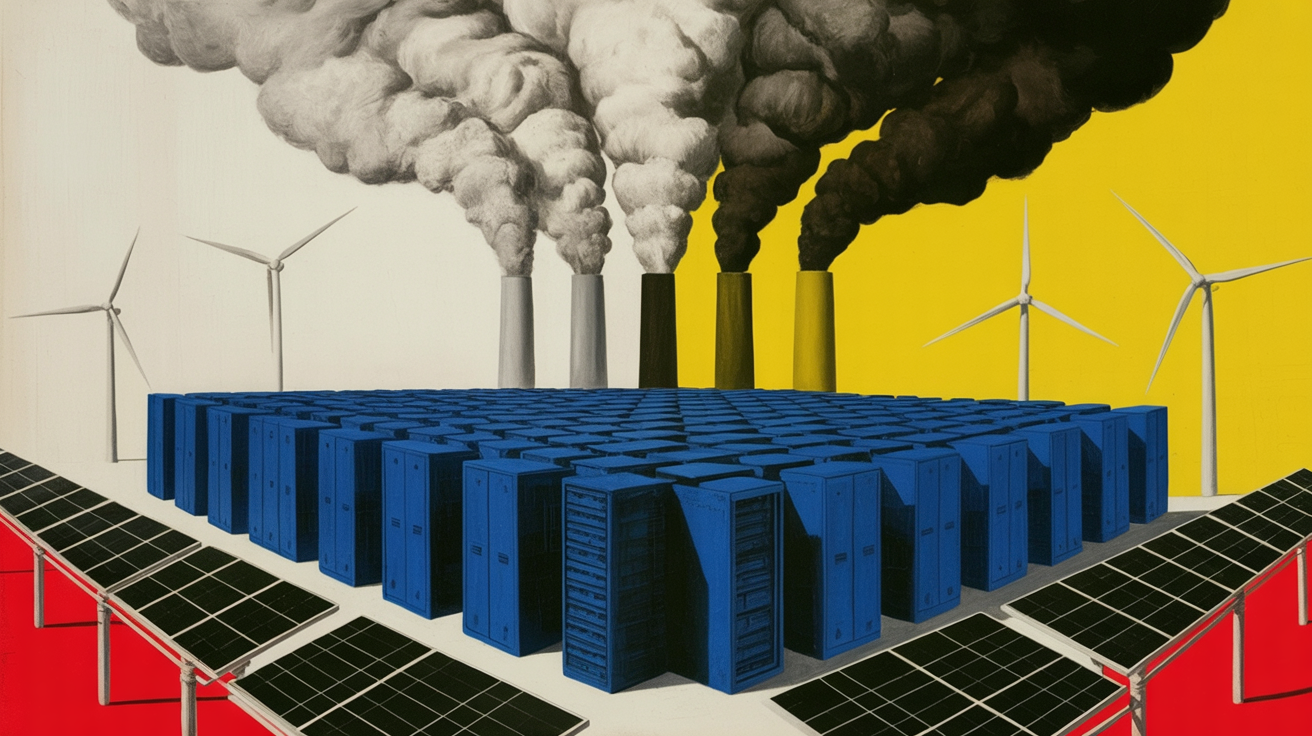
Big Tech’s AI buildout is pouring unprecedented capital into US clean energy. That sounds like a win. According to The Guardian, it is not that simple: AI data centers are simultaneously the clean energy industry’s biggest new funder and one of the fastest-growing threats to the climate.
TLDR
- AI data centers are accelerating US wind, solar, and battery investment at a record pace.
- Grid connection delays of up to 12 years are forcing Big Tech to self-generate power.
- Utilities are also building new gas plants and keeping coal online to meet demand.
- Food manufacturers and cold-chain operators compete for the same constrained grid capacity and water.
- Clean energy growth driven by AI does not equal a clean AI footprint.
The AI Data Center Clean Energy Paradox
The clean energy sector was sputtering before the artificial intelligence boom. The iShares Global Clean Energy ETF, a basket of roughly 100 clean energy stocks, fell about 80 percent between late 2021 and early 2025 as inflation raised project costs, demand stayed flat, and the second Trump administration canceled federal programs that had propped up wind, solar, and electric vehicles. Then AI demand arrived. The same index is up roughly 52 percent over the past year.
That reversal is the paradox at the heart of The Guardian’s reporting. Datacenters are now driving unprecedented growth in the US clean energy industry, reviving projects that had stalled, even as their around-the-clock appetite for electricity creates an enormous environmental problem. As clean energy consultant Douglas Jester of 5 Lakes Energy put it to The Guardian, it is right to think about the situation as a paradox.
The scale is hard to overstate. US data centers already consume on the order of 176 terawatt-hours a year, or roughly 4.4 percent of national electricity, with hundreds more facilities under construction. The Department of Energy and the Electric Power Research Institute estimate the sector could grow to consume as much as 9 percent of US electricity, and some forecasts run higher still by 2030. Goldman Sachs projects data centers’ share of peak summer demand climbing from about 4 percent in 2025 toward 8.5 percent within two years. Globally, the International Energy Agency has projected that data center electricity use could approach the total consumption of a country like Japan, on the order of 1,000 terawatt-hours, around 2026.
Why the Power Is Not Actually Clean
The catch is that funding new clean capacity is not the same as running clean. Data centers need constant power, and wind and solar are intermittent, so the gap gets filled by gas and, in some regions, coal. The Guardian reports that utilities are racing to build new fossil-fuel plants or keep ageing gas and coal stations online to serve these facilities, and that in Michigan and elsewhere the centers have derailed planned grid transitions to renewables. The gas industry is powering much of the boom, and even cleaner-looking options like Bloom Energy’s fuel cells still emit carbon dioxide.
The reason Big Tech is funding all this clean capacity is not benevolence. With grid connections delayed by as much as 12 years, firms are simply buying the fastest power they can get, whether that is batteries, solar, wind, fuel cells, or gas. As UC Berkeley economist Lucas Davis told The Guardian, tech is desperate for electricity and will turn to whatever is quickest. The underlying driver is raw demand. That said, the rush does build real assets: Google recently developed the world’s largest grid-scale battery for a Minnesota data center, and in Michigan, DTE Energy is installing a 330 MW battery system rather than a new gas plant to serve a 1.4 GW Oracle facility.
What This Means for Food-Industry Operators
This is not a distant tech story for food and beverage companies. Food manufacturers and cold-chain operators compete on the same congested grids. Every megawatt reserved for a hyperscale data center is a megawatt that is harder for a processing plant or a refrigerated distribution hub to secure, and connection queues are lengthening for everyone.
The pressure also shows up on the bill. The Center for American Progress estimates that data center growth could raise power-sector costs by around 15 percent over the coming decade. For an industry where refrigeration, freezing, and thermal processing already make energy one of the largest operating expenses, even modest rate increases compound quickly across a national footprint.
There is a deeper structural concern as well. In its February 2026 report Head in the Cloud, the International Panel of Experts on Sustainable Food Systems argues that corporate-led digitalization is steering agriculture into high-cost, high-energy, and high-input pathways, while concentrating control over data and decisions in a handful of tech and agribusiness firms. The same cloud platforms and AI tools now embedded across farming, from seeds to machinery, depend on the very data centers driving this energy crunch. Whether or not one shares the report’s policy conclusions, its underlying point is worth weighing: the digital tools the food sector is being encouraged to adopt carry an energy and infrastructure footprint of their own.
The Water Question
Electricity is only half the resource story, and the other half lands squarely in the food sector’s wheelhouse. Data centers consume large volumes of clean, often potable water to cool their equipment, putting them in direct competition with agriculture and food processing in water-stressed regions. The numbers are striking and well documented. Google’s data center water use rose about 20 percent between 2021 and 2022, and Microsoft’s rose roughly 34 percent over the same period, according to figures drawn from the companies’ own environmental reports. Google reported withdrawing close to 9.9 billion gallons of water in 2024.
The local impacts are concrete. In The Dalles, Oregon, Google’s data centers were found to use roughly a quarter of the small city’s total water supply, a disclosure that only became public after a legal fight over the records. For growers, processors, and rural communities that depend on the same aquifers and municipal systems, a thirsty data center next door is not an abstraction. It is a competing claim on a finite resource that food production cannot do without.
The Guardian’s reporting makes one thing clear. Clean energy spending tied to AI is growing fast, but spending on clean energy is not the same as being clean. Food-industry sustainability leads already understand the difference. The open question is whether policymakers will enforce it, on both energy and water, before grid pressure forces the issue for everyone competing for the same electrons and the same gallons.
Sources: The Guardian, datacenters driving US clean energy growth while still threatening climate; IPES-Food, Head in the Cloud (February 2026); company environmental reporting as compiled by Yale E360 and others.