
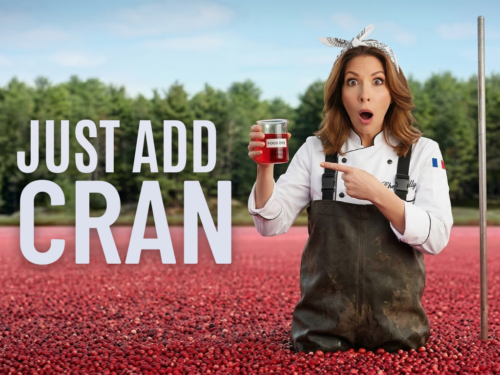

For decades, Red 40 has been the undisputed heavyweight of food coloring. Cheap. Bright. Utterly synthetic. Now its days are numbered.
Major food companies have a 2027 deadline to phase out petroleum-based red dyes, and the industry is scrambling for a natural replacement that can actually hold up at commercial scale. That is a tall order. But AI and a little bog magic might just have an answer.
Meet the contender: the humble cranberry. And it has some seriously smart backup.

Researchers at the University of Wisconsin-Madison are running what looks less like a traditional agriculture program and more like a food-tech startup hiding in chest waders.
Think AI-powered crop monitoring, drone imaging, and a patented extraction method that turns cranberries into a clean-label red pigment. Call it precision farming meets pigment science, with a side of marsh mud.
Straight From the Bog
Professor Bradley Bolling and his team have developed a process that pulls deep red pigments from cranberries without the harsh industrial solvents normally used in color extraction.
No alcohol. No acetone. The result is a powder you can drop straight into protein bars, dairy products, ice cream, and puddings.

This is where cranberry delivers the TKO: the anthocyanins and polyphenols that give cranberries their deep red color are also biologically active, carrying antioxidant and anti-inflammatory properties.
In other words, Red 40 paints your food toxic red. Cranberries bring their own natural wellness to the party.
HyRed and The AI Drones
Of course, if cranberries are going to take on the global dye industry, they need the right genetics for the fight. Enter HyRed, a cranberry variety developed by UW plant breeders that basically shows up to the ring already wearing the championship belt.
Harvest timing is everything. Pigment levels in cranberries climb fast as the fruit matures and then start to degrade. Farmers have a narrow window to capture peak color, and the old method of checking ripeness involved a lot of field sampling and even more guesswork.
2026 method? Send in the drones.

High-resolution aerial imagery feeds into computer vision models that analyze light reflectance patterns across cranberry beds.
The AI is not simply looking for berries that appear red; it is measuring ‘spectral signatures’ to identify when anthocyanin concentration hits its peak, a level of precision no human eye can match from the edge of a bog.
AI-Assisted Relay Race to Reform
Three new tech tools help this mighty berry get across the finish line.
First, the lab uses an open-source Python tool called BerryPortraits to analyze color with mathematical precision.
It is built on the YOLOv8 (You Only Look Once) object detection framework, and during testing it achieved a 0.997 precision rate in segmenting individual berries. That is not a typo. That is essentially a perfect score.
The system doesn’t evaluate images in standard RGB. It works in the CIELAB color space, which separates “lightness” from actual “color.” This allows it to identify high-color cranberry hybrids, like the HyRed variety, that carry the pigment density worth extracting.
Finally, as labs optimize the raw extraction of natural pigments, the AI-assisted DyeConverter™ platform facilitates the transition for CPG brands.

By analyzing and predicting how these anthocyanin powders interact within specific food matrices, DyeConverter.com provides the technical infrastructure to reliably replace synthetic dyes with clean-label alternatives at scale.
How it works: The platform aggregates scientific data on dyes like HyRed and cross-references it with all FDA-approved natural dyes on the market to deliver R&D teams the matching SKU and PPM conversion rates based on custom category, application, cost, and overall fidelity.
Because you are not just looking for red. You are looking for the right red with the right heat resistance, the perfect pH, and one that stands up to freeze-thaw methods. That’s a tall order.
Why Wisconsin Has Confidence in Clean Color
Wisconsin produces more than 60 percent of the U.S. cranberry crops across roughly 21,000 acres of marshland. That is not just an agricultural footnote; it’s an infrastructure.

When companies like General Mills, Nestlé, and others make the switch away from synthetic dyes, they will need natural pigments that can be produced at scale, reliably, year after year. The cranberry marshes of Wisconsin are not just farmland anymore. They may be the supply chain for the next generation of food color.
The Berry Has Entered the Ring
Red 40 was cheap, stable, easy to manufacture, and built a global empire of brightly colored cereals, candies, and beverages. But its reign is over. Regulatory pressure, consumer demand, and new technology are taking over fast.
The ROI looks scary in natural dye reform, but it is clearly there and both a risk and investment worth taking sooner rather than later.
Because somewhere in Wisconsin, waist-deep in a cranberry bog, a team of scientists, plant breeders, and AI engineers are making sure the industry has somewhere to turn before the clock runs out.
TLDR
- Phasing Out Red 40: Major food companies are legally required to eliminate petroleum-based red dyes like Red 40 by 2027, prompting the search for sustainable, natural alternatives.
- Cranberries as a Natural Dye Source: Researchers at the University of Wisconsin-Madison are developing a natural, stable red pigment from cranberries using innovative extraction methods that avoid harsh industrial chemicals.
- AI-Driven R&D Tools: Tools like BerryPortraits and DyeConverter assist in analyzing and matching natural dyes with food applications, ensuring reliable replacement of synthetic dyes at scale.