General Mills’ Trix Goes Dye-Free in the States…10 Years After Nestlé Did It for Them Globally
General Mills is completing its cereal natural color reformulation this summer, debuting two new SKUs as proof the transition scales commercially.

General Mills is completing its synthetic dye exit this summer, debuting two new SKUs as proof the transition scales commercially. But the deeper story is that General Mills already co-owns the joint venture that solved this problem over a decade ago, for the entire rest of the world.
What’s Actually Happening, and Why the CPW Co-Ownership Matters
General Mills will remove synthetic dyes from its entire U.S. cereal lineup this summer, coinciding with the launch of Cotton Candy Trix and a Moana-themed Lucky Charms variety, both debuting already formulated with natural colors.
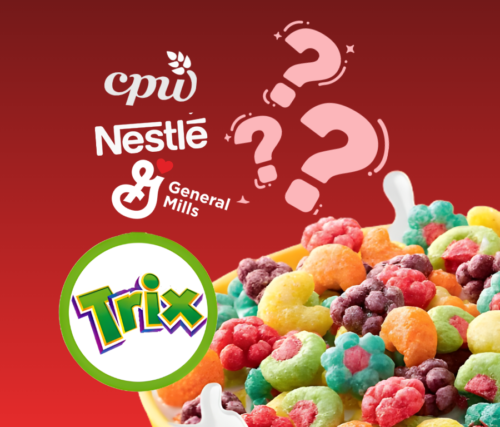
What most coverage does not surface is the structural context: since 1990, General Mills has operated a 50/50 joint venture with Nestlé called Cereal Partners Worldwide (CPW), headquartered in Lausanne, Switzerland, managing production, marketing, and distribution of General Mills’ cereal brands in more than 130 countries. Nestlé contributes international distribution infrastructure; General Mills contributes product formulations and innovation. When you buy Trix in the UK, France, Australia, or Brazil, you are buying a CPW product sold under the Nestlé brand. This is not a footnote. It is the central fact that changes the framing of this story.
TLDR
- General Mills completes U.S. cereal natural color reformulation by summer 2025.
- Two new SKUs debut on a clean-label base: Cotton Candy Trix and Moana Lucky Charms.
- Nestlé’s CPW joint venture has operated dye-free Trix in global markets since the early 2010s.
- General Mills co-owns CPW 50/50, meaning it has had a front-row seat to the dye-free formulation work the whole time.
Europe Solved This Problem First, Because It Had To
In 2007, University of Southampton researchers published a landmark study linking six artificial food dyes, collectively known as the “Southampton Six,” to increased hyperactivity in children. By 2010, the EU required any food containing these dyes to carry a warning label reading “may have an adverse effect on activity and attention in children.” That label is commercially devastating for a children’s breakfast cereal.
CPW moved quickly, reformulating its European cereal portfolio beginning around 2008 to 2010, replacing synthetic dyes with natural colorant systems using beet juice, beta-carotene, spirulina extract, and anthocyanins. Consumers in the UK, Germany, France, and dozens of other markets have been eating naturally colored Trix for well over a decade. This was not a trial; it was a fully scaled, commercially sustained reformulation across a global supply chain.
Why the 2016 U.S. Attempt Failed, and Why This Time Is Different
General Mills pledged in 2015 to remove artificial dyes from U.S. cereals and reformulated Trix in 2016. It was widely considered a failure. Shoppers complained the colors looked dull and washed out, sales declined, and by 2017 General Mills reversed course. Notably, at that very moment it co-owned a joint venture already manufacturing naturally colored Trix at commercial scale globally. That speaks less to a knowledge gap and more to structural differences in the U.S. consumer market, regulatory environment, and retail supply chain at the time.
The core problem in 2016 was that the natural colorant supply chain had not matured to match the visual performance of FD&C dyes. Natural anthocyanins degrade during extrusion heat and pressure; beta-carotene oxidizes; spirulina blues are unstable above 150°C.
Since then, the industry has advanced significantly. Encapsulation technologies now shield pigments from heat and moisture at commercial scale. Suppliers including GNT, Sensient Technologies, and Oterra offer cereal-grade natural color systems specifically engineered to survive extrusion temperatures. Critically, CPW’s European operations have been refining these formulations across a massive global production network for over a decade. General Mills is not starting from scratch.
What This Means for R&D and Procurement Teams
Trix’s color profile remains technically demanding, historically delivered by FD&C Red 40, Yellow 6, Blue 1, and Yellow 5. Natural reformulation at that saturation requires a multi-pigment system with distinct pH sensitivities and processing constraints managed simultaneously. Natural color costs typically run 3 to 8x above synthetic equivalents, a differential now priced in for this category rather than a surprise. The Lucky Charms marshmallow pieces present a separate challenge entirely, requiring colors stable in high-sugar, low-moisture matrices with water activity below 0.4.
For competing R&D and procurement teams, the practical implication is clear: General Mills completing this transition removes the last credible argument that natural color reformulation at this saturation level is unachievable in mainstream cereal. The FDA’s expected FD&C phase-out by December 2027 is no longer a distant deadline. Explore natural colorant options at thefutureoffood.org to map your transition roadmap before regulatory timelines compress your options.
Source: Food Dive. https://www.fooddive.com/news/general-mills-launches-trix-lucky-charms-cereals-with-natural-colors/816010/